
Every summer, right around the time everyone else is soaking up the last few weeks of freedom, I’m sitting down with a glass of iced matcha and a blank notebook trying to figure out how to plan homeschool curriculum for the upcoming year. It used to overwhelm me. So many programs, so many opinions, so much pressure to get it “right.” But over the years I’ve built a simple process that takes the guesswork out of it, and I wanted to walk you through exactly how I do it.
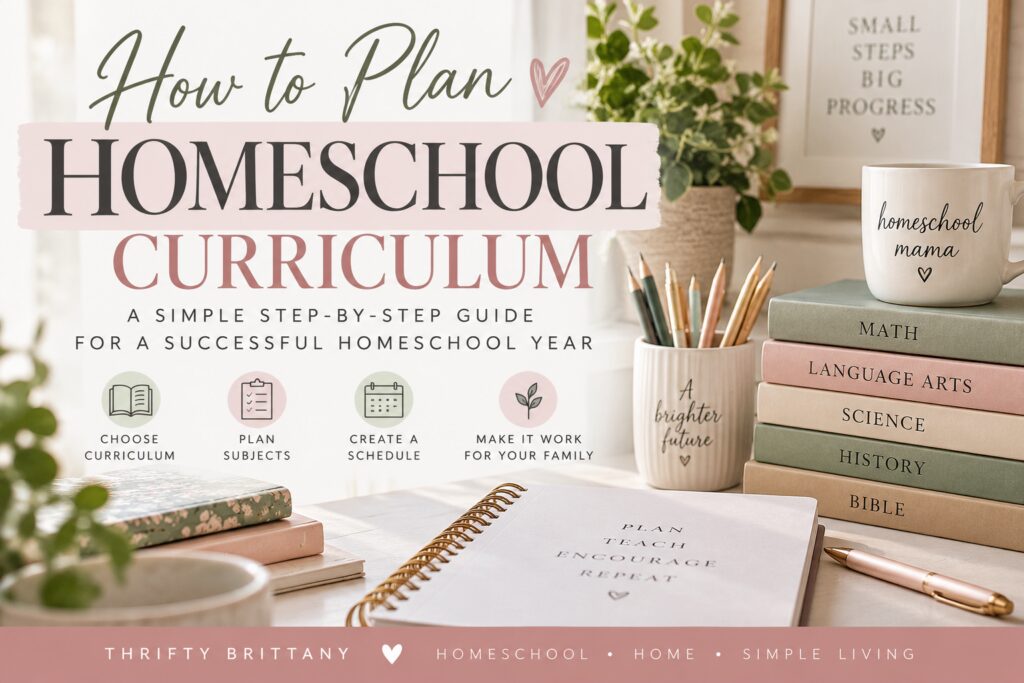
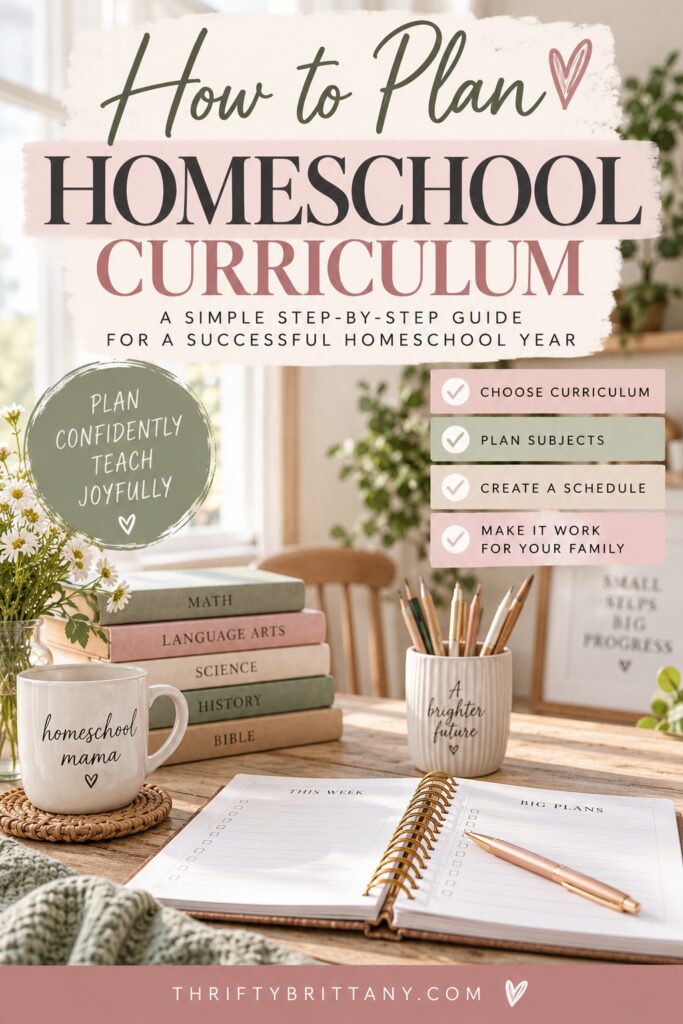
How to Plan Homeschool Curriculum Step by Step
Start With Your Why, Not the Curriculum Catalog
Before I look at a single curriculum, I ask myself why we’re homeschooling in the first place. For us, it’s never been about recreating school at home. it’s about raising kids who love learning, not just survive it. Every curriculum decision gets filtered through that lens. If a program feels like it’s adding pressure instead of curiosity, it’s probably not the right fit, no matter how popular it is.
Take ten minutes and write down your own “why.” It’ll make every decision after this one so much easier.
Look Up Your State’s Homeschool Laws and Grade-Level Requirements
Before you even look at curriculum, look up your state’s homeschool requirements. Every state handles homeschooling differently. Some just require a simple letter of intent, others ask for standardized testing, portfolio reviews, or specific subjects to be covered at each grade level.
I check this every single year, not just when we started, because requirements can shift and grade-level expectations change as my kids move up. Knowing exactly what’s required keeps me from either under-planning (and accidentally falling out of compliance) or over-planning (and adding pressure that isn’t even necessary). A quick search for “[your state] homeschool requirements” plus your state’s Department of Education homeschool page will usually give you the full picture in about fifteen minutes.
Get Clear on Each Child’s Learning Style First
This is the step most new homeschool families skip and it’s the one that saves the most time and money. A curriculum that works beautifully for one kid can completely flop for another, not because the program is bad, but because it doesn’t match how that child actually learns.
Before you buy anything, figure out whether your child is a visual, auditory, hands-on, or reading-and-writing learner. It changes everything about which curriculum will actually work for your family instead of sitting on a shelf half-finished by October.
👉 This is exactly why I built FREE learning style quiz! It walks you through a few quick questions and gives you curriculum picks matched to your child’s specific learning style, so you’re not guessing. Take the quiz below and I’ll send the full curriculum guide straight to your inbox.

DISCOVER YOUR CHILD’S UNIQUE LEARNING STYLE
Find out how your child learns best and get a FREE personalized homeschool curriculum guide with my top homeschool curriculum recommendations.
Map Out Subjects Before Shopping
Once I know how each kid learns, I make a simple list of the subjects we’re covering that year. Math, language arts, science, history, and anything extra like art or a foreign language. I don’t shop curriculum yet. I just get clear on what needs to be covered so I’m not buying based on pretty packaging or a trending reel.
Choose Curriculum That Matches, Not Just What’s Popular
This is where the learning style piece really pays off. For my hands-on learners, I lean toward programs like Math With Confidence and All About Spelling both use games and manipulatives instead of worksheets, so lessons actually stick instead of turning into a daily battle. For a reading-and-writing learner, I’d look for literature-rich programs instead. The “best” curriculum isn’t a universal answer, it’s whatever actually fits the kid sitting in front of you.
Build a Loose Rhythm, Not a Rigid Schedule
I don’t plan out every single day in advance, that’s a fast way to burn out by October. Instead, I sit down with my homeschool planner and build a loose weekly rhythm: which subjects happen which days, roughly how long each one takes, and where our natural rest days fall. Having everything in one planner instead of scattered across notes and screenshots is honestly what keeps our whole year from falling apart by November.
I use my planner to map out the big picture first — terms, breaks, and any co-op or extracurricular days — then fill in a simple weekly rhythm underneath that. It’s not a rigid, hour-by-hour schedule. It bends when life happens, which it always does.
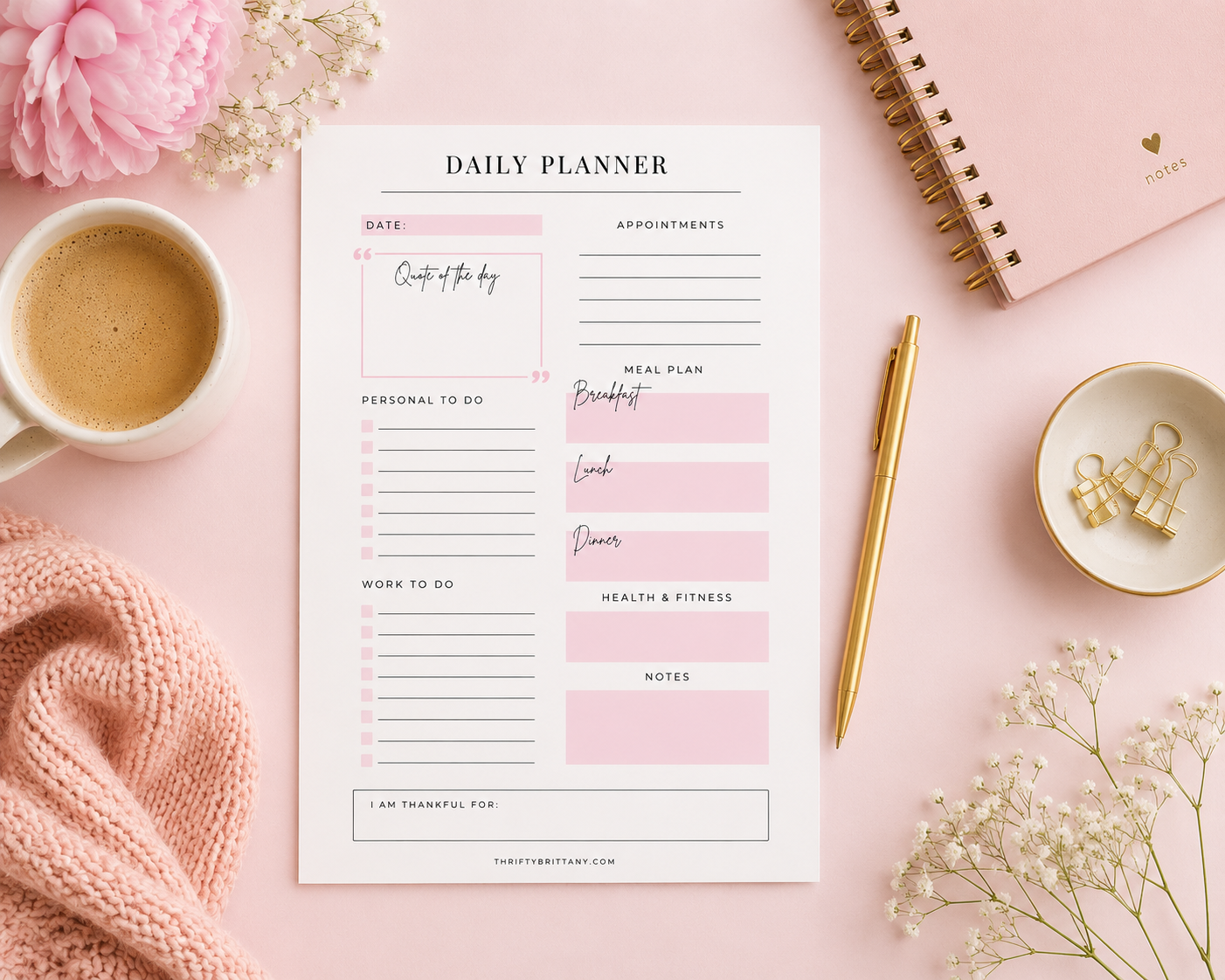
👉 Want to see how I map out a full year at a glance? Grab my free daily planner page to get started, or check out my full Busy Homeschool Mom Planner if you want the whole system — term mapping, weekly rhythm pages, and daily logs all in one place.
Leave Room to Adjust
No matter how much planning I do in July, something always shifts by October. A curriculum that looked perfect on paper turns out to be a poor fit, or a kid surprises me by loving a subject I thought they’d resist. I plan the year loosely enough that adjusting isn’t a failure, it’s just part of homeschooling well. Now that you know how to plan homeschool curriculum take my learning style quiz to find out which curriculum would work best for your child’s unique learning style.
Want more homeschool ideas?
Follow @thrifty_brittany on Instagram for homeschool planning tips, curriculum recommendations, printables, and encouragement for busy homeschool moms.
Frequently Asked Questions About Planning Homeschool Curriculum
How to plan homeschool curriculum?
Start by identifying the subjects your child needs to study, your state’s homeschool requirements, and your child’s age, interests, and learning needs. Then choose curriculum for each subject, decide how many days per week you want to teach, and create a simple weekly homeschool schedule. You don’t have to plan every minute of the day focus on creating a realistic routine your family can actually maintain.
What subjects should I include in my homeschool curriculum?
ommon homeschool subjects include math, language arts, reading, spelling, science, and social studies or history. Depending on your child’s age and your family’s goals, you may also include art, music, foreign language, geography, health, physical education, and electives. Check your state’s requirements to make sure you cover any required subjects.
How far in advance should I plan my homeschool curriculum?
Many homeschool families plan their curriculum for the entire school year before they begin, but you don’t have to have every lesson planned in advance. A good approach is to choose your main curriculum before the year starts and then plan your lessons in smaller section, such as monthly or weekly. This gives you room to adjust when something isn’t working.
How do I choose the right homeschool curriculum for my child?
Consider your child’s learning style, age, interests, strengths, challenges, and attention span, as well as your teaching style and budget. Look for curriculum that fits your family’s goals rather than choosing something simply because it is popular. If possible, look at samples before purchasing so you can see whether the lessons are a good fit.
How many homeschool subjects should we do each day?
You don’t necessarily need to teach every subject every day. Many homeschool families focus on core subjects such as math and language arts daily while rotating subjects like science, history, art, and geography throughout the week. The best homeschool schedule is one that gives your child enough learning time without making your day unnecessarily complicated.
How long does it take to homeschool each day?
Homeschooling often takes less time than a traditional school day because you aren’t managing a classroom of 20–30 students. The amount of time needed depends by age, curriculum, and child. Younger children generally need shorter lessons, while older students may need more independent work. Quality and consistency are more important than filling a specific number of hours.
Can I change my homeschool curriculum during the school year?
Yes! You don’t have to finish a curriculum just because you purchased it. If your child is consistently frustrated, the lessons aren’t a good fit, or the curriculum isn’t helping your child learn, it’s okay to make a change. Homeschooling gives you the flexibility to adjust your approach as your child’s needs change.
How do I create a homeschool schedule that actually works?
Start with your family’s natural rhythm rather than trying to recreate a traditional school schedule at home. Choose the subjects you want to complete each day, estimate how long each lesson will take, and leave room for breaks, meals, errands, appointments, and unexpected interruptions. A simple homeschool routine is often easier to maintain than a highly detailed schedule.
Do I need to follow a homeschool curriculum exactly?
No. Most homeschool curriculum can be adapted to fit your family. You can skip unnecessary repetition, slow down when your child needs more practice, move ahead when your child has mastered a concept, or supplement a lesson with additional resources. Your curriculum is a tool, not a rulebook.
How do I plan homeschool curriculum on a budget?
Start by deciding which subjects truly need a full curriculum and which can be supplemented with library books, free printables, educational websites, field trips, and hands-on activities. Buying used curriculum, borrowing from homeschool friends, and choosing reusable resources can also significantly reduce costs.

Leave a Comment